Property Types We Roof
Restaurant Roofing in New Bedford, MA
Grease-aware roof inspection, exhaust-fan curb repair and membrane replacement for restaurants near New Bedford, MA, scheduled around service hours.
Request a Roof Assessment
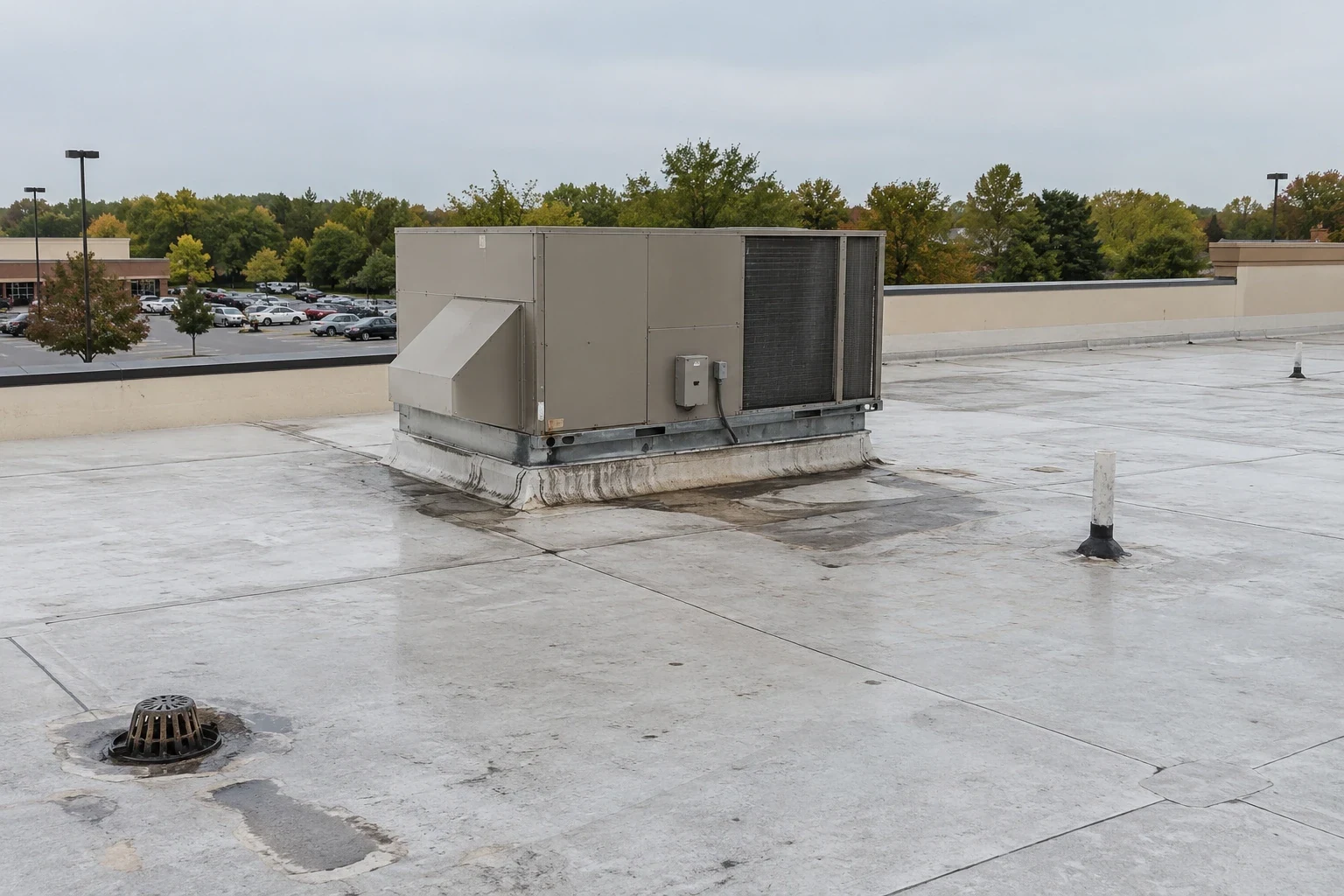
Who cleans the exhaust fan, and who repairs what it leaves behind on the roof? A restaurant owner near New Bedford, MA usually has a contract for the first and no plan for the second, which is why the membrane around the hood fan is often the oldest-looking sheet on the building. The first thing an inspector finds on a restaurant roof is a dark, soft patch around the fan and a streak running toward the nearest drain, where grease has done what weather alone could not. We probe the seams in that zone, test the sheet for softness and mark the path the grease takes on the roof plan.
The rest of the roof is usually in better shape than the fan zone, and the repair and replacement decisions should treat the two separately.
What does the inspector find around a kitchen exhaust fan?
Kitchen exhaust leaves a film that thickens with each cleaning cycle and with each windy day that carries mist away from the fan. On many membranes, grease causes swelling, softening and blistering. We press the sheet near the fan, look for surface tackiness, check the curb flashing for cracking and follow the film to the drain, where it can coat the sump and slow the flow.
Beyond the fan we find walk-in cooler condensers, makeup air units and plumbing vents. Each has a boot or a curb, and each sits where service staff walk. Fastener back-out and lap sealant failure show where traffic and heat concentrate. The result is a repair list sorted by zone: fan, units, drains and field.
Roof access is the last item on the walk. A restaurant roof is reached by a ladder through a hatch or from the outside, and staff often carry grease buckets, filters and tools across the sheet. We note whether walk pads lead from the hatch to the fan and recommend them where the sheet is bare.
Why does the roof membrane choice matter over a kitchen?
Not every roofing sheet tolerates fats and oils. Some swell and lose strength when grease sits on them; others resist it. In the single-ply family, PVC and KEE sheets are formulated for kitchen exhaust exposure, and they are the usual choice around the fan even when the rest of the roof is TPO or modified bitumen.
We do not recommend replacing a sound roof because of one bad zone. Instead, we cut out the damaged area, install a compatible sheet with a properly flashed curb and add a grease containment tray under the fan outlet. That keeps the cost within a repair budget and protects the new sheet from the same wear.
A restaurant owner also faces a timing problem. A fan zone can be repaired in a day, but ordering the correct sheet and curb flashing can take a week, so we recommend scheduling the repair before the heavy months, when kitchens are busiest and a ceiling stain costs the most.
Where do the region's restaurants put their roofs under strain?
Seekonk's Route 6 strip of chain stores and restaurants is one example, and the working waterfront in New Bedford sits at the port that was the most valuable US commercial fishing harbor from 1999 to 2019. A seafood kitchen, wherever it stands, adds refrigeration, wash-down water and heavy exhaust to its rooftop equipment, and each of those attacks a membrane in its own way.
Free-standing restaurants on a pad site have a small roof with a large amount of equipment on it. Restaurants in a strip share a roof with neighbors, and a leak that begins at one tenant's fan can stain the next unit's ceiling. Either way, the roof plan records which tenant owns each piece of equipment, which helps when a repair has to be assigned.
How do snow and drainage change a small restaurant roof?
Snowfall in New Bedford runs to 32.5 inches in an average year, mostly December through March. A small restaurant roof has little room for it to go. Snow stacks against the fan housing, melts toward the curb and refreezes at night, and the water finds any gap in the flashing. Where a drain or scupper is clogged with grease and leaves, the water backs onto the membrane and sits.
We clear and check drains and scuppers before winter, set grease containment where the outlet drips and look for stains along the drain path. A restaurant that adds a drain-cleaning visit to its fan-cleaning contract protects the roof for very little cost.
What does storm wind do to a restaurant roof?
The wind record here includes Hurricane Carol in 1954, with 80 to 110 mph across eastern Massachusetts, and Hurricane Bob in 1991, with 89 mph gusts over Buzzards Bay. A restaurant roof has a small field and tall equipment, so wind loads the fan housing, the hood and the parapet before they load the membrane. A loose fan cover or a shifted curb can open the roof in the first hard gust.
We check restraint straps, curb fasteners and edge metal, and we look at the flashing at the base of every unit for signs that wind has moved it. If a storm has just passed, a quick check of the fan zone can catch a small opening before rain makes it a ceiling stain.
What should an owner ask before the roof comes up?
Ask when the crew will be on the roof relative to lunch and dinner service, how odor and noise will be controlled near dining areas and how the kitchen will be protected if a section stays open. Ask which membrane will go around the fan and what will be done to keep grease off it. Ask for a photograph of the finished flashing at every curb.
The same planning serves a hotel kitchen or a grocery store deli, with larger equipment and longer hours.
Ask for the cost of the fan-zone repair as a separate line from any larger roof work, so a small decision is not buried inside a large one.
Commercial Roofing Questions
How can an owner tell whether grease has damaged the roof membrane?
Look near the fan for a dark, soft or tacky area, blistering or a sheet that has swelled upward. Press with a gloved finger: a healthy membrane is firm, a damaged one feels spongy. We test and photograph the area, then mark how far the damage extends so the repair can be sized correctly.
Is a containment tray worth installing under an exhaust fan?
Yes, in most cases. A tray catches the grease that would otherwise run across the membrane, and it can be emptied during routine fan cleaning. It costs little next to the replacement of a damaged sheet, and it helps the new membrane survive the same exposure that harmed the old one.
Can a restaurant stay open during a roof repair?
Usually. Repairs near the fan often take a day or less, and replacement can be done in sections timed around service. The crew keeps noise down at peak hours, protects air intakes from fumes and closes every section before evening. The owner gets notice of each stage so the kitchen team can plan.
Why does the same leak return above a dining room after a patch?
Because the patch fixed where the water showed, not where it entered. Grease residue also keeps patches from bonding. We trace the stain to the roof, clean the surface properly, replace the damaged area with a compatible sheet and log the location so a repeat can be compared with the repair.
How often should the roof around a kitchen fan be checked?
At least twice a year, in spring and fall, and again after a major storm. Grease builds slowly, and a short visit that probes the sheet, checks the curb flashing and clears the drain path is enough to spot damage while it is still a small repair. The visit is logged so that the trend around the fan is visible over time.
Ready to review the roof scope?
Request a Roof AssessmentKeep Reading