Roof Damage Repair
Ponding Water Roof Repair in New Bedford, MA
Ponding water repair in New Bedford, MA finds the drain, deck or insulation fault behind the puddle and marks the fix on the roof plan. Send the plan.
Request a Roof Assessment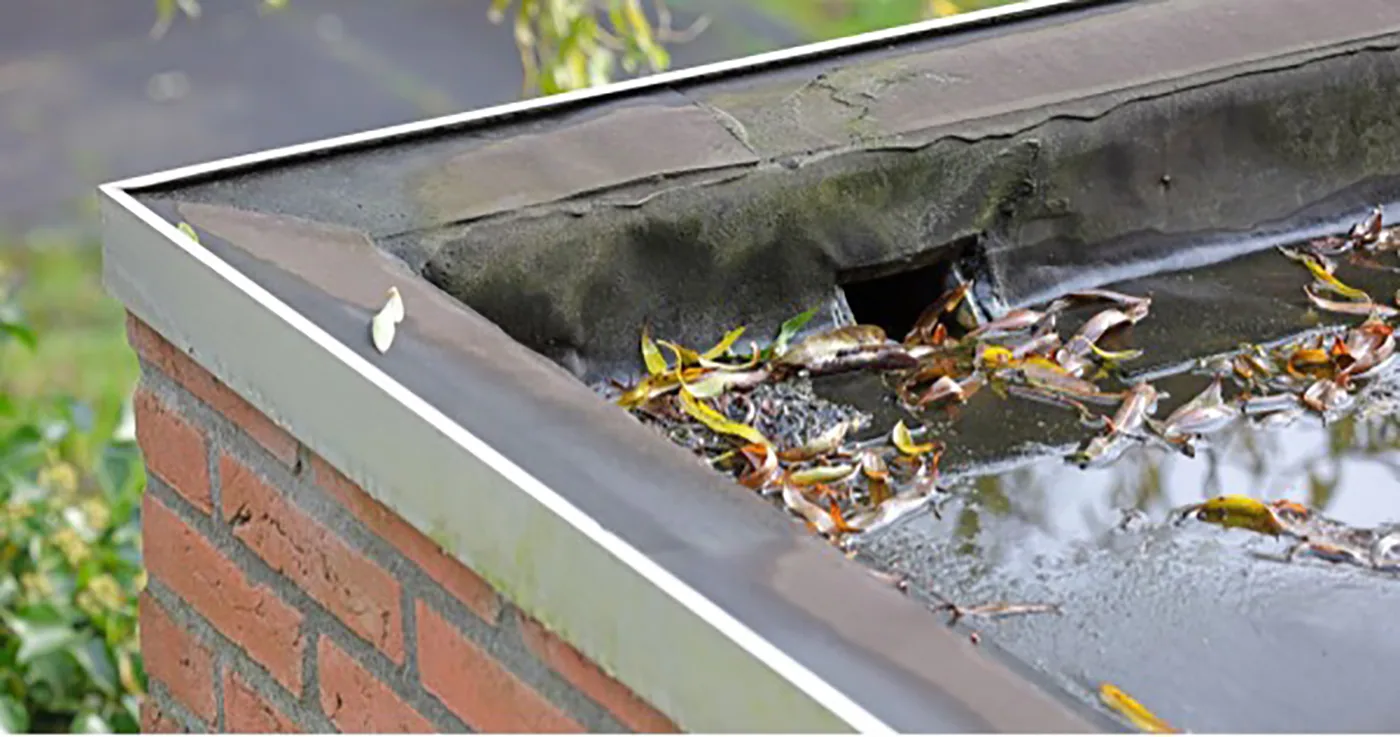
Does standing water mean the membrane has failed? Not by itself, and a facility director who pays to replace a sound sheet over a bowl-shaped deck will see the puddle return within a season. The first thing an inspector marks on a ponded roof in New Bedford, MA is the drain sump and the slope around it, because water that stays behind after a storm is telling you where the roof has stopped moving it toward an outlet, and that is a drainage and structure question before it is a membrane question.

Where is the water supposed to go?
On a low-slope roof the path is meant to be continuous from the high point to a drain, a scupper or a gutter, and every break in that path is a place where a pond can form. We trace it with a level, a straightedge and a hose, noting where the fall flattens, where a drain sits above the surrounding membrane instead of in a shallow sump, and where an equipment curb forms a dam across the flow.
New Bedford takes about 52 inches of precipitation across roughly 124 days a year, so a roof gets many chances to show its low spots. Each puddle that outlasts a normal drying period goes on the plan with a depth, a rough outline and a note about what lies upslope.
Surge history adds one more question for buildings near the harbor. In New Bedford the 1991 surge from Bob peaked at 5.8 feet, while Carol's 1954 tide set the 20-foot record. A roof is not flooded by surge, but heavy rain arriving with a storm can overwhelm outlets that were barely coping, so a drain that struggles in an ordinary storm deserves attention before hurricane season, not after it.
What does standing water do to the membrane itself?
Water that sits on a sheet concentrates dirt and biological growth in the pond line, and the surface in that line ages faster than the dry membrane around it. Lap seams that sit beneath water are loaded constantly, and a weld with a marginal bond lets go there first, which is why a seam probe across a ponded area often finds the opening that explains the stain below.
Winter adds ice. A pond that freezes pulls at every edge it touches, and the next thaw leaves the membrane a little looser, so an area that holds water in October often holds a crack by March. Weight matters as well, since a roof carrying a pond and a layer of snow carries load in one spot that the original design spread out.
Why do older masonry buildings pond in particular places?
The Wamsutta, Hathaway and Kilburn mills are among the many 19th-century mill buildings in the New Bedford Mill District, and a building of that age can carry several generations of roof, with drains added later and slopes altered by each reroofing. We look for where the fall was interrupted, and often the answer is a wall tie-in, an addition or a drain installed at the wrong elevation.
Through-wall flashing and parapet terminations matter here as well, because a pond against a masonry wall puts a constant head of water on the base flashing, and a termination that would shed ordinary rain can leak under a standing load.
What is the insulation doing underneath the pond?
A long-standing puddle often sits over wet board. A pinhole in the sheet or an open lap lets water in, the insulation soaks it up and holds it, and the roof loses insulating value and gains weight in exactly the place where the deck is already deflecting. A moisture scan after sunset shows the warm, wet zone, and a core cut at its edge confirms the board is saturated.
Wet insulation comes out and is replaced before anything is laid over it. Tapered boards or crickets then restore the fall toward the drain, and the membrane goes back over dry material. Skipping the scan and patching the membrane leaves the saturated board in place to freeze and spread.
Which repairs actually remove the pond?
The list is short. Clear and test the outlet. Set the drain in a proper sump, or replace a drain body that sits high. Add a scupper or an overflow where the roof has none. Build tapered crickets behind curbs and along valleys so water has somewhere to go. Each of these falls under drain and scupper work, which we price as its own line so the owner can approve it first.
Coatings have a narrow role. A silicone coating tolerates standing water better than most materials and can protect a sound membrane in a low area that cannot be re-sloped, but it does not move water and it does not close a leak. We say so before the quote so the owner chooses for the right reason.
After any of these corrections the roof gets a second look following the next substantial rain, with the pond outlines compared against the plan, so the owner knows whether the fix moved the water or only moved the problem.
How does snow change the timing?
With about 32.5 inches of snow in an average year, mostly December through March, drains are tested hardest when the ground is frozen and crews are least able to open a roof. A drain that is half blocked in November is fully blocked by the first thaw, and the meltwater then ponds against seams that are already cold and brittle. Clearing outlets before the first storm and again after the first heavy thaw is the cheapest protection a roof gets, and it ties directly into the snow and ice damage checks we run on the same roof.
Fall River sits on hillsides rising more than 200 feet from the water, and snowmelt on any roof there still has to find an outlet. A roof whose fall converges on a single drain sends water to it from several directions, and when that drain clogs the pond appears everywhere at once.
Commercial Roofing Questions
How long may water sit before it counts as a defect?
Water still present a couple of days after the last rain is the line most inspectors use. Whether the pond outlasts dry weather is the test, because short-lived puddles in small dips are common and long-lived ones point to slope, drain height or deck movement.
Will a new membrane cure ponding?
No, unless it is laid over corrected slope. The fall toward the drain comes first, so we address tapered insulation or crickets first and let the membrane follow. A new sheet over the same bowl just repeats the puddle.
Does ponding void a membrane warranty?
Many manufacturers list standing water as an exclusion, so read the document before work begins. The exact wording governs, and correcting drainage keeps the roof inside the terms and removes the cause.
Can a drain be added to an existing deck?
Usually, if the structure permits a core through the deck and the plumbing can be routed. Structural capacity decides it, and we coordinate with the building engineer when the deck must be cut.
What does the report show after a ponding survey?
A plan with each pond outlined and measured, the drains and their elevations, the moisture result and a ranked repair list. Elevation differences decide the order, because the lowest area usually needs the first fix.
Can ponding be measured rather than eyeballed?
Yes, with a level, a straightedge and a tape taken a day after rain, plus a hose test on suspect areas. Pond depth and outline go on the plan, and those numbers let the owner compare the roof after repair with the roof before.
Ready to review the roof scope?
Request a Roof AssessmentKeep Reading