Roofing Manufacturers
Holcim Elevate Roofing Systems in New Bedford, MA
Holcim Elevate (formerly Firestone Building Products) roofing in New Bedford, MA: EPDM, TPO and metal systems probed, repaired and documented by condition.
Request a Roof Assessment
Which name is on the roof, and does it matter when the ceiling tile stains? A facility director who finds Firestone on an old membrane label and Holcim Elevate on a newer invoice is looking at the same manufacturer under a changed name, and the first thing an inspector would find on either roof is the condition of the seams, flashings and terminations. Holcim Elevate, formerly Firestone Building Products, makes EPDM rubber, TPO and other single-ply membranes, along with insulation, metal edge products and accessories. Within New Bedford, MA we install, repair and maintain these system types, and each finding is written onto the roof plan ahead of any talk about scope.
Why does the old Firestone name still turn up on roofs and records?
A roof outlives the company branding on its paperwork. A membrane installed years ago carries the earlier name on its labels, its warranty papers and its repair history, while newer material and current documents carry the later one. For an owner, the practical effect is that records may sit under two names, and a search for the roof's history needs to cover both. Firestone UltraPly is a long-established single-ply name that still appears on older roofs.
We write both names into the roof file when a building has them, together with the system type, thickness and installation date as far as they are known. That makes it easier to match a repair to the original details and to answer a warranty question quickly. Our roof warranty management work keeps those documents in one register with the repair log.
The same habit helps when a roof changes hands. A buyer or a new facility manager inheriting a building needs to know what system is on the roof, who installed it, what repairs have been made and what the next inspection is due to examine. An incomplete file forces a fresh survey before any decision, while a complete one lets the new owner start from the last known condition and see what has changed since.
What does an inspector find on an aging EPDM roof?
EPDM is a cured rubber sheet, and with age it hardens, shrinks and loses elasticity. The first findings are usually at flashings, where the sheet was stretched around a curb or a pipe, and at splices, where tape or adhesive can lift. Shrinkage pulls the membrane toward the middle of the field and puts tension on every termination, so we check for bridged corners and open edges along parapets. A seam probe along the full length of each splice tells us which sections still hold.
Where the sheet is sound but a few details have failed, a repair is practical: new flashing, reworked splices and replaced pipe boots. Where hardening is widespread and repairs are recurring, replacement or a recover is the sensible conversation. On an EPDM roof, a cold January often turns a marginal flashing into an open one.
TPO from the same manufacturer behaves differently: it is a welded thermoplastic, so we probe the weld instead of the splice, check for chalking on the surface and look at membrane shrinkage at walls. Metal edge products and fascia systems are inspected for fastener back-out and movement at joints, because they take the first wind load at the perimeter. Each component gets its own line in the report so a repair can be targeted precisely.
How do hurricanes and blizzards shape a South Coast inspection?
The region has measured what severe weather does. Eight feet of water stood over New Bedford after the 1938 hurricane, Carol set a 20-foot tide record in 1954, and Bob's 1991 visit meant a 5.8-foot surge and 89 mph gusts over Buzzards Bay. A roof's perimeter is its exposed side in those storms, so edge metal, gravel stops and termination bars are checked by hand for movement and corrosion.
Winter is the quieter stress. Fall River received 24.1 inches and East Freetown 26.0 inches in the January 2015 blizzard, and an ordinary New Bedford winter brings 32.5 inches. Snow loads every low spot, and meltwater must reach a drain that may be partly frozen. We inspect drain sumps, tapered crickets and scuppers before the season, and our snow and ice roof damage repair work addresses what a heavy winter leaves behind.
What matters on larger industrial and distribution roofs?
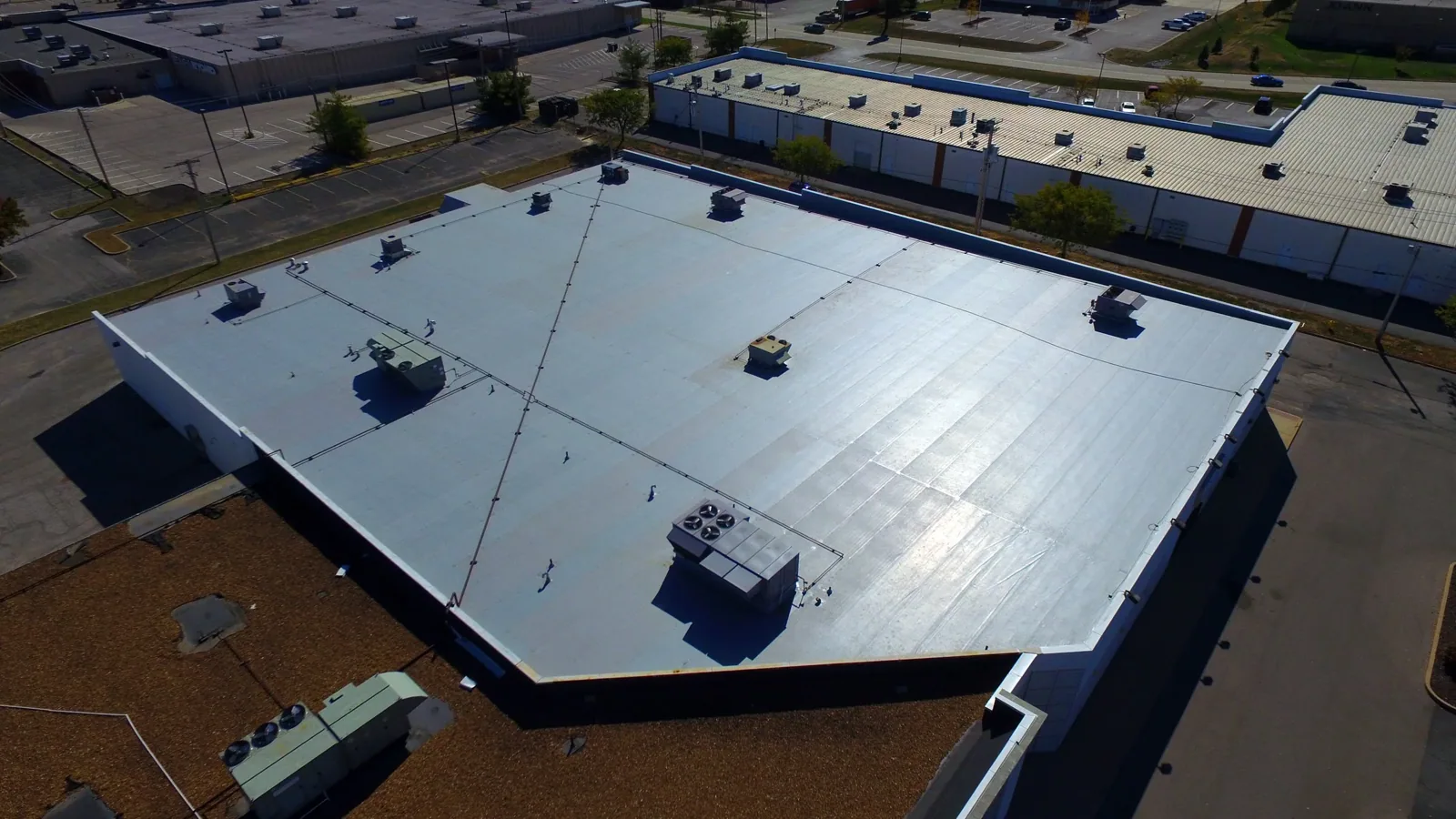
The Fall River Expressway, Route 24, serves Freetown, Berkley and the Fall River Industrial Park, and Route 140 ties Taunton's Route 24 to New Bedford's I-195 by way of Lakeville. A building along these corridors with a large low-slope roof has long seam runs, many penetrations and rooftop units, and on such a roof the count of seams, curbs and drains drives both the inspection time and the repair cost.
We survey in a pattern, probing seams by section, photographing each curb and logging drain condition. A written commercial roof inspection gives the owner a ranked list, and the Fall River Industrial Park is one place where that kind of survey scales across several roofs. Work is staged so deliveries and operations continue, with sections closed each day.
How should an owner decide between repair, recover and replacement?
Moisture settles most of it. A moisture scan and core cuts show whether insulation is dry. Dry and sound points toward repair or recover; wet and spreading points toward tear-off. The second test is recurrence: if the same details fail again and again, the repair budget is paying for a problem that a rebuild would end. The third is the deck, since a corroded or damaged deck changes the scope.
Price drivers follow from those tests: area, penetrations, wet material removed, deck repair, insulation value and phasing. Winter limits some adhesives, so the season also affects timing. A Carlisle SynTec or Sika Sarnafil roof is inspected by the same method, family by family.
A written scope version carries all of this. It names the membrane, thickness and attachment method, the insulation and cover board, the flashing and edge metal, the drainage corrections and the cleanup. Putting those items in writing before work starts lets the owner compare bids on equal terms and prevents the cheapest number from quietly omitting the details that matter most in a hurricane or a blizzard.
Bring any past proposals as well: an earlier scope that listed layer thickness or attachment pattern lets us compare what was installed with what the core cut finds today.
Commercial Roofing Questions
Is a Firestone roof the same as a Holcim Elevate roof?
The manufacturer is the same business under a changed name. A roof labeled Firestone and a roof labeled Holcim Elevate are inspected the same way, by system type, and we keep both names in the file where they appear.
What signals that EPDM flashing has reached the end of its life?
Stretch marks, cracks, open corners and a flashing that no longer rises tight against the wall. Pull-back from the termination and hardened rubber at pipe boots are other signs. We probe each one and mark it on the plan.
Does shrinkage always mean the roof needs replacing?
No. Minor shrinkage can be handled by reworking terminations and adding flashing, provided the field is still sound. Widespread hardening and recurring tears point toward replacement.
What is the usual first step on a large industrial roof?
A sectioned survey with seam probes, curb photographs and a drain log. It yields a ranked list so the owner can tackle the most urgent areas first and plan the rest by capital year.
Can you coordinate work with warehouse operations?
Yes. We confirm dock schedules, fire lanes and rooftop access with the site manager, and plan sections small enough to close each day.
Ready to review the roof scope?
Request a Roof AssessmentKeep Reading