Roof Damage Repair
Flashing Failure Repair in New Bedford, MA
Flashing failure repair in New Bedford, MA rebuilds wall-to-roof transitions, parapet terminations and curb flashings, with each joint marked on the plan.
Request a Roof Assessment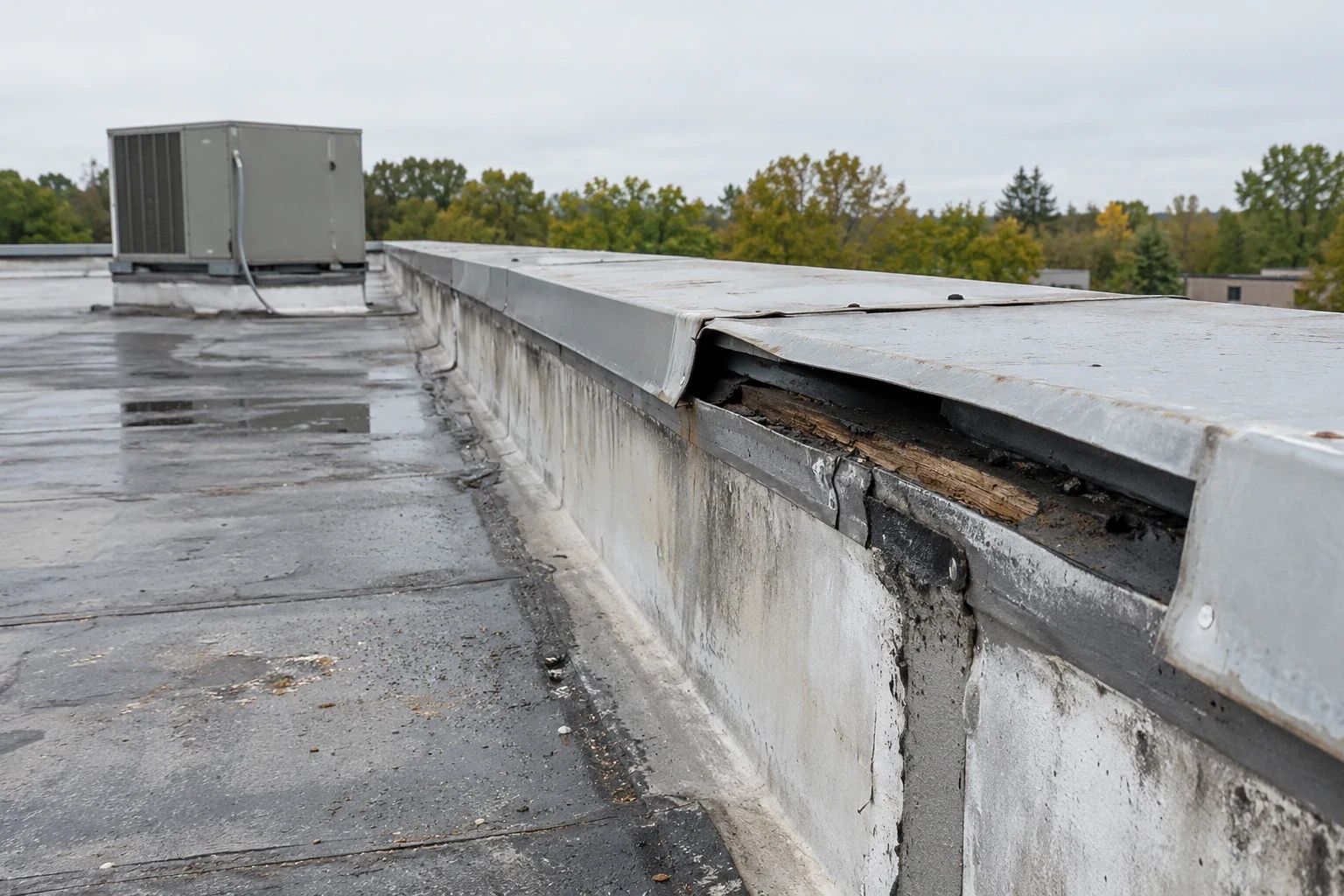
Which joint is the water really using? A stain on a ceiling tile rarely sits below the opening, and on most commercial roofs in New Bedford, MA the opening is a flashing: the strip of membrane or metal that turns up a wall, wraps a curb or seals a pipe, and that has to move with the building while keeping a continuous barrier against rain. The inspector finds it by working outward from the stain to the nearest transition, and then asks why that joint moved.
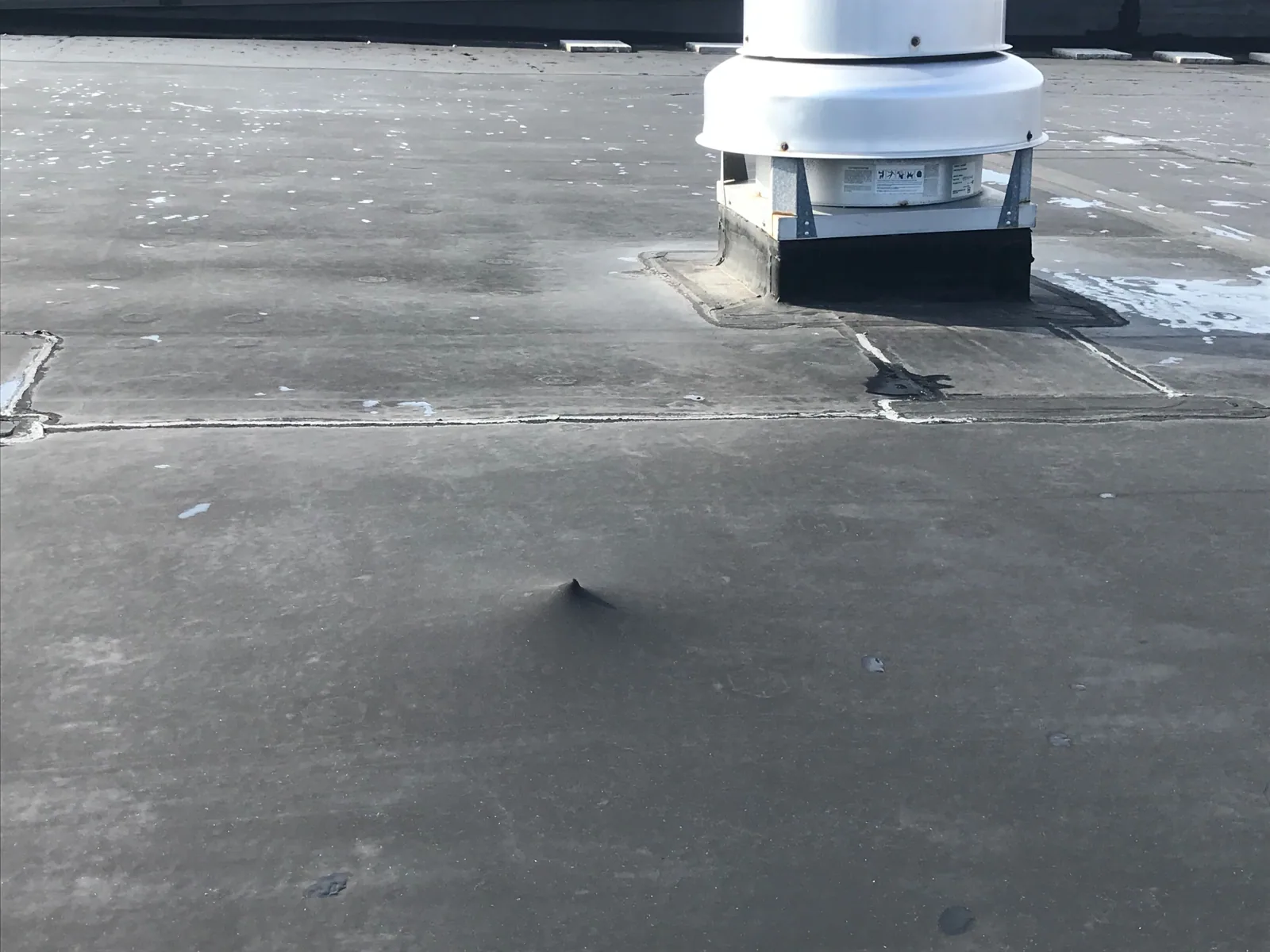
What does the inspector mark at a wall-to-roof transition?
We look for membrane shrinkage first, because a sheet that has pulled back from the wall leaves the base flashing under tension and often opens a gap at the corner where the horizontal and vertical surfaces meet. Then the fasteners and the termination bar along the top edge, then the sealant bead above it, and then the wall itself, since a bar fixed to crumbling mortar holds nothing.
On a single-ply roof the base flashing is usually a separate piece welded or adhered to the field, so the lap between the two is also a seam and gets probed like one. Every gap, lifted edge or dried sealant joint goes on the plan with a number and a photograph, and the repair list follows that sequence.
Height matters on the wall side. Flashing that terminates only a few inches above the roof surface sits in the zone where splash, drifted snow and ponded water reach it, and a taller termination, fixed with a surface-mounted bar and a sealed top edge, keeps those loads below the line of the barrier. We note the termination height at each wall because it often explains why one wall leaks and its neighbor does not.
Why do parapet terminations fail before the field does?
A parapet receives water from two directions, from the roof side and from the top of the wall, and its termination is the place where the two meet. When the cap or the top flashing opens, water runs behind the membrane and down the inside of the wall, and the first sign appears in the building below, often far from any visible defect on the roof surface.
The granite and red-brick mills of Fall River show how much masonry edge a roof may have to meet, and the 19th-century mill buildings in the New Bedford Mill District have wall junctions that deserve the same scrutiny. We open a small section, look at the wall and the flashing behind it, and decide whether the termination needs resetting, rebuilding or replacing with a through-wall assembly.
What does through-wall flashing do in an old brick parapet?
Through-wall flashing carries water that has entered the masonry back out to the face of the wall before it can run down inside the building. Where it is missing, cracked or buried under repointing, moisture migrates through the brick, stains the interior wall and freezes in the joints, and surface repairs on the roof side cannot touch the cause.
We trace the stain, check the weep points and compare the wall condition above and below the flashing line. If the through-wall piece has failed, the parapet is opened locally, the flashing is replaced and the masonry is closed before the roof-side flashing is reconnected. The sequence matters, because a new membrane flashing over a wet wall fails as fast as the old one did.
How do curbs, pipes and rooftop equipment open?
A curb flashing fails at the corners, where the membrane has to fold around a right angle and thins as it stretches, and a pipe boot fails where the rubber or sealant has cracked in the sun. Equipment that vibrates, settles or is serviced often loosens its own flashing, and a curb that has been shifted by a technician can pull its flashing off the substrate.
We check each one for cracked sealant, lifted edges, fastener back-out and signs that something has moved, and we test the support under the unit before repairing around it. Where the geometry is awkward, a liquid-applied detail is often more reliable than sheet material, and the plan notes which method each item received. The same attention applies at skylights and penetrations and at equipment curbs, where the support itself can be the cause.
What do freeze-thaw cycles do to a termination?
About 32.5 inches of snow falls on New Bedford each winter, mostly December through March, the record low is minus 12 F, and total precipitation tops 52 inches across roughly 124 days. Water that enters a hairline gap at a termination freezes overnight, expands, and leaves the gap larger when it thaws, so the same defect that was invisible in October is plainly open by March.
That is why flashing repairs are best made before the cold, and why a small crack found during a fall visit is cheaper to correct than a stained ceiling in January. The same cycle drives the snow and ice damage we find at drains and eaves.
Hurricane Bob's 1991 gusts of 89 mph and the record 20-foot storm tide of Hurricane Carol in 1954 are reminders that wind-driven rain also reaches details a normal storm never wets. A termination that sheds vertical rain can admit rain driven sideways at storm speed, so we examine the upper edges and the lap sealant after any named storm.
When does the repair become a perimeter project?
One failed curb flashing is a repair. Failed terminations along most walls, corroded edge metal and a membrane that has shrunk away from the parapets are evidence of a roof whose perimeter has aged out, and repeated patches there cost more than rebuilding the edge. We lay out both paths with cost drivers and expected life, and we walk the roof with the owner before anything is quoted. Where wind is part of the cause, the wind damage checks apply to the same edge, and the edge metal list belongs in the same scope.
Commercial Roofing Questions
Can failed flashing simply be re-caulked?
Sealant over a moving joint lasts a season at best. The cause is movement or a failed termination, so we rebuild the joint with compatible membrane or liquid-applied material and terminate the top edge properly.
How do we tell a flashing leak from a seam leak?
Position tells most of the story. Stains near walls, curbs, pipes and drains point to flashing, while stains in the open field point to seams or punctures. We probe both, and a hose test with someone watching the ceiling settles the unclear cases.
Does repointing the parapet come before or after flashing work?
Before, when the mortar is open. Water entering the wall defeats a new flashing, so the masonry is closed first and the roof-side flashing reconnected over sound material.
What warranty issues arise on flashing repairs?
Many manufacturers specify termination details and compatible materials, so a repair that departs from them can complicate a claim. We match the repair to the system and photograph each step for the file.
What will the flashing report include?
A numbered plan of every transition, curb and penetration, a photograph of each defect, the repair method used and a note of anything left open, so the next inspector can start where we stopped.
What if the wall behind the flashing is wet?
Dry it out and find where it is entering before closing anything. Moisture scanning along the wall and a look at the through-wall piece and the cap show the source, and the wall repair is made first so the new flashing has a sound surface to bond to.