Property Types We Roof
Apartment Roofing in New Bedford, MA
Multifamily roof inspection, leak tracing and resident-aware replacement for apartment buildings and mill conversions near New Bedford, MA.
Request a Roof Assessment
How much notice does a resident deserve before a crew steps onto the roof above their ceiling? A property manager near New Bedford, MA answers that every time a work order comes in, because an apartment roof is also someone's ceiling, and the person under it has a lease, a schedule and a phone. The first thing an inspector finds on a multifamily roof is that the stain in the unit and the failing detail on the roof are several feet apart, and that the unit above the stain is not always the unit the water came through. We probe the seams, trace the stain to its entry and mark the findings by building, stair and unit number.

That unit-based plan is what the manager hands to a tenant, a contractor or an owner's representative when someone asks which roof is leaking and why.
What does the inspector find on a multifamily roof?
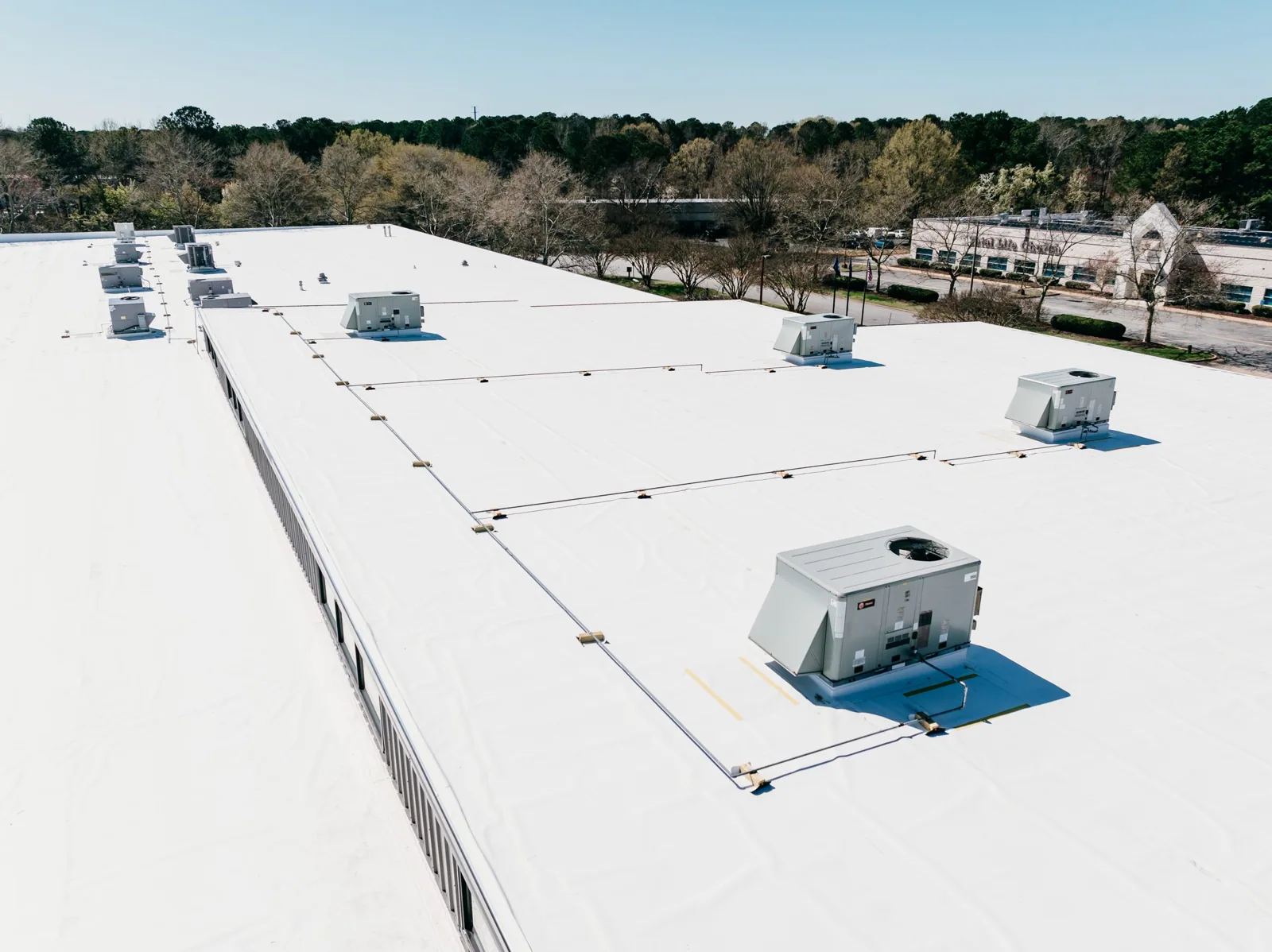
Apartment roofs carry a surprising amount of small equipment: bathroom and kitchen exhaust vents, plumbing stacks, boiler or water-heater flues, satellite dishes and, in many buildings, rooftop mechanical units. Every one is a penetration through the membrane with its own boot. Exhaust vents are the usual offenders, since they run for hours each day and their dampers rattle against the flashing.
We check each boot for cracking, each flue collar for rust and each unit curb for open seams. We note fastener back-out on the field, lap sealant that has dried at the walls and membrane shrinkage at stairwell bulkheads. The repair list is grouped by building so the manager can order the work stairwell by stairwell.
Stair bulkheads and lift penthouses on larger buildings deserve their own walk. Their walls rise above the main roof, their flashing sits at the junction of two materials and their doors are opened by maintenance staff all year. We grade each one separately from the field.
Why does a resident complaint come before the roof report?
Residents see a stain before a manager sees a roof. By the time a work order arrives, water may have been moving for weeks through insulation and drywall, and mold can already be a concern. The sooner a manager can match the complaint to a roof detail, the smaller the repair and the lower the risk to the resident.
That is why we recommend a standing relationship with the roofer and a short list of response steps: log the complaint with a unit and a date, send photographs of the stain, call for an inspection and give the roofer the access contact. The same discipline lets a property management company compare buildings fairly.
There is a financial side as well. A dated log of complaints, inspections and repairs gives an owner or a lender the evidence for a replacement reserve, and it keeps an argument about a roof from turning into an argument about memory.
Where do mill conversions and newer complexes differ?
O'Bannon Mill in Barrington was converted to elderly apartments in the 1990s, and Fall River and Warren both have textile mills from the nineteenth century, Warren's first cotton mill being erected in 1847. A converted mill often carries masonry walls, parapets and roofs rebuilt several times over a long life, while a newer garden-style complex usually has lower parapets and simpler flashing.
Each type has its own failure pattern. Mills fail at the masonry interface and at through-wall flashing; garden-style roofs fail at penetrations and at the edges. Swansea had 6,904 housing units and Seekonk had 6,057 at the 2020 census. A complex in Swansea or Seekonk gets the same inspection routine.
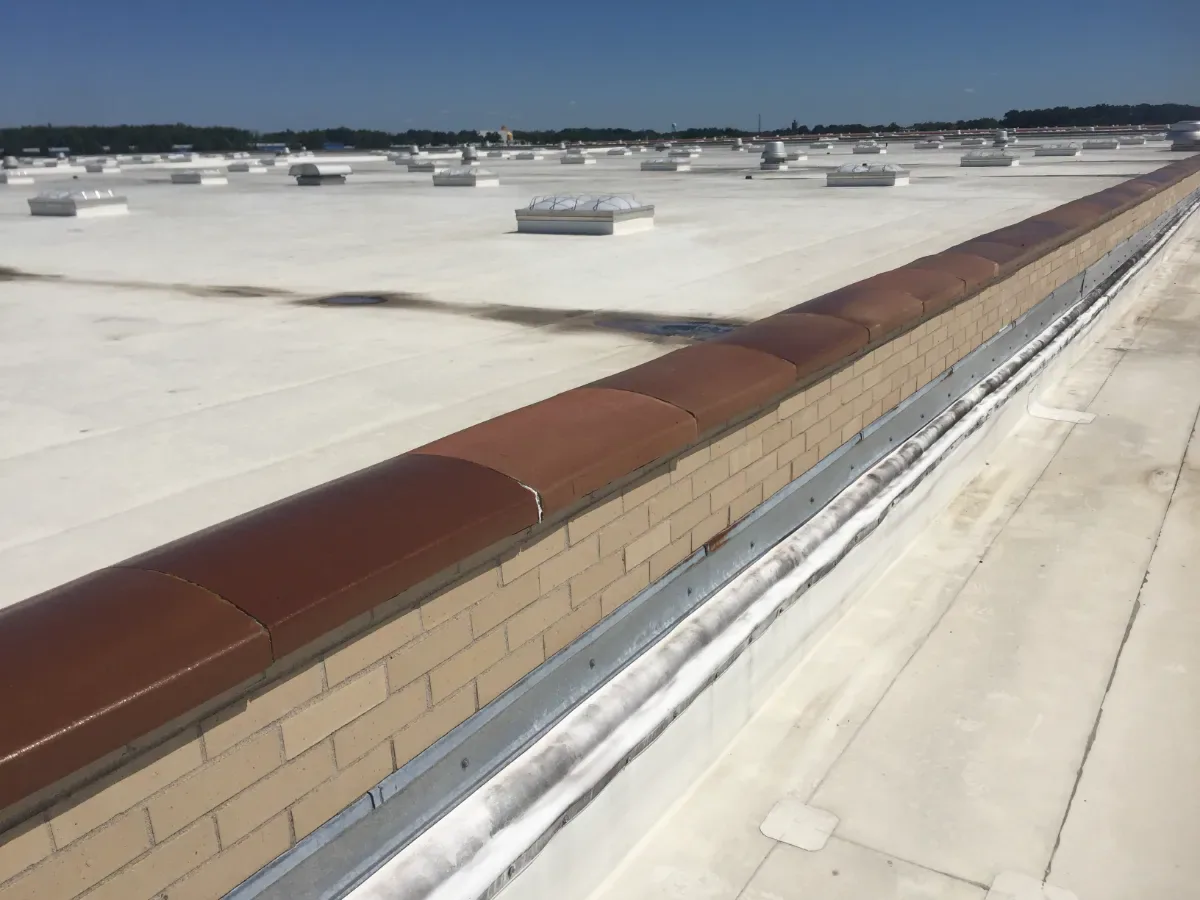
A mill conversion deserves a longer first visit than a garden complex. We walk the parapet from the inside and the outside, probe the coping joints and photograph every place where a pipe or a ladder penetrates the masonry, because the repair plan starts with the oldest and most expensive detail on the building.
What does snow do to an apartment roof?
Over a typical year 32.5 inches of snow fall, mostly December through March, and the 2015 blizzard put 24.1 inches on Fall River. Snow sits on a flat residential roof for weeks, melts from below where heat escapes and refreezes at the eaves and drains. Ice at a drain sump sends water under the sheet, and the first sign is a stain at an exterior wall.
We clear and check drains and scuppers before winter, look at attic and top-floor insulation for heat loss, and recommend that managers keep drains free of debris through the season. A top-floor unit that stains every March is usually telling us about a drain or a parapet, not about the weather.
Attic and top-floor ceilings show the other half of the winter story. Warm air leaking past an unsealed hatch or a bath fan duct melts snow from below and feeds ice at the drain, so we look at the ceiling side of the roof assembly when the building allows and note any duct that ends short of the vent.
How does coastal wind treat residential roofs?
A residential roof on this coast is measured against two storms: Carol in 1954, with 80 to 110 mph winds over eastern Massachusetts, and Bob in 1991, with 89 mph gusts across Buzzards Bay. Apartment roofs have exposed edges, rooftop vents and, on some buildings, stair bulkheads that take wind from every side. A lifted edge or loose coping lets rain into the wall cavity, where it does damage no resident can see until a ceiling stains.
We check edge metal and coping at every perimeter, tighten or replace what has backed out, and look at flashing where the roof meets walls. After a named storm, a quick perimeter check can catch an opening before the next rain.
Balconies and walkways that tie into the roof edge add details that change the flashing. Where a rail post or a bracket passes through the membrane, we seal it and photograph it, since those posts are small, numerous and easy to forget.
What should an owner ask before an occupied-building reroof?
Ask how residents will be notified, when the noisy work happens and how access to units is handled if a ceiling must be opened. Ask about parking and material staging, because tenants notice a dumpster in their lot. Ask how a leak during the project will be handled at night.
The same questions apply to senior living buildings and, with different hours, to hotel roofs, where guests are in their rooms all day and noise matters even more.
Commercial Roofing Questions
How should a manager log a roof leak so it can be traced?
Record the unit, the date, the weather and a photograph of the stain, plus the location of any equipment above it. A short note about earlier stains in the same unit helps most. The roofer then starts with the nearest penetration or drain, and the repair is tied back to the complaint.
Can residents stay in their units during a roof replacement?
Generally yes. Work proceeds in sections with notice to the residents below, noisy tasks timed for the middle of the day and protection at entrances. Where a ceiling must be opened, the manager arranges access. The plan sets the hours and the notice period before the first day.
What makes a converted mill roof harder than a modern complex?
The masonry. Through-wall flashing, deep parapets and old coping stones create joints that open slowly and are hard to see. A new membrane over a failed termination will leak again, so we inspect the masonry interface first and repair it before any new sheet goes on.
When in the year does an apartment roof most need a second look?
Spring, after the winter freeze and thaw, with a quick drain check each fall. Buildings with repeat leaks or an aging membrane deserve a shorter interval. The report records the findings by building, so trends are visible over several years.
What does a roof reserve for a multifamily building depend on?
On the age and system of each roof, the repair history, the condition grades and the planned replacement year. A reserve built from a dated inspection and a list of open findings holds up better than one based on age alone, because it shows which roofs are failing early and which are performing beyond expectation.
Ready to review the roof scope?
Request a Roof AssessmentKeep Reading