Property Types We Roof
School Roofing in New Bedford, MA
Flat-roof inspection, repair and summer replacement planning for schools and academies around New Bedford, MA, with emergency response for leaks.
Request a Roof Assessment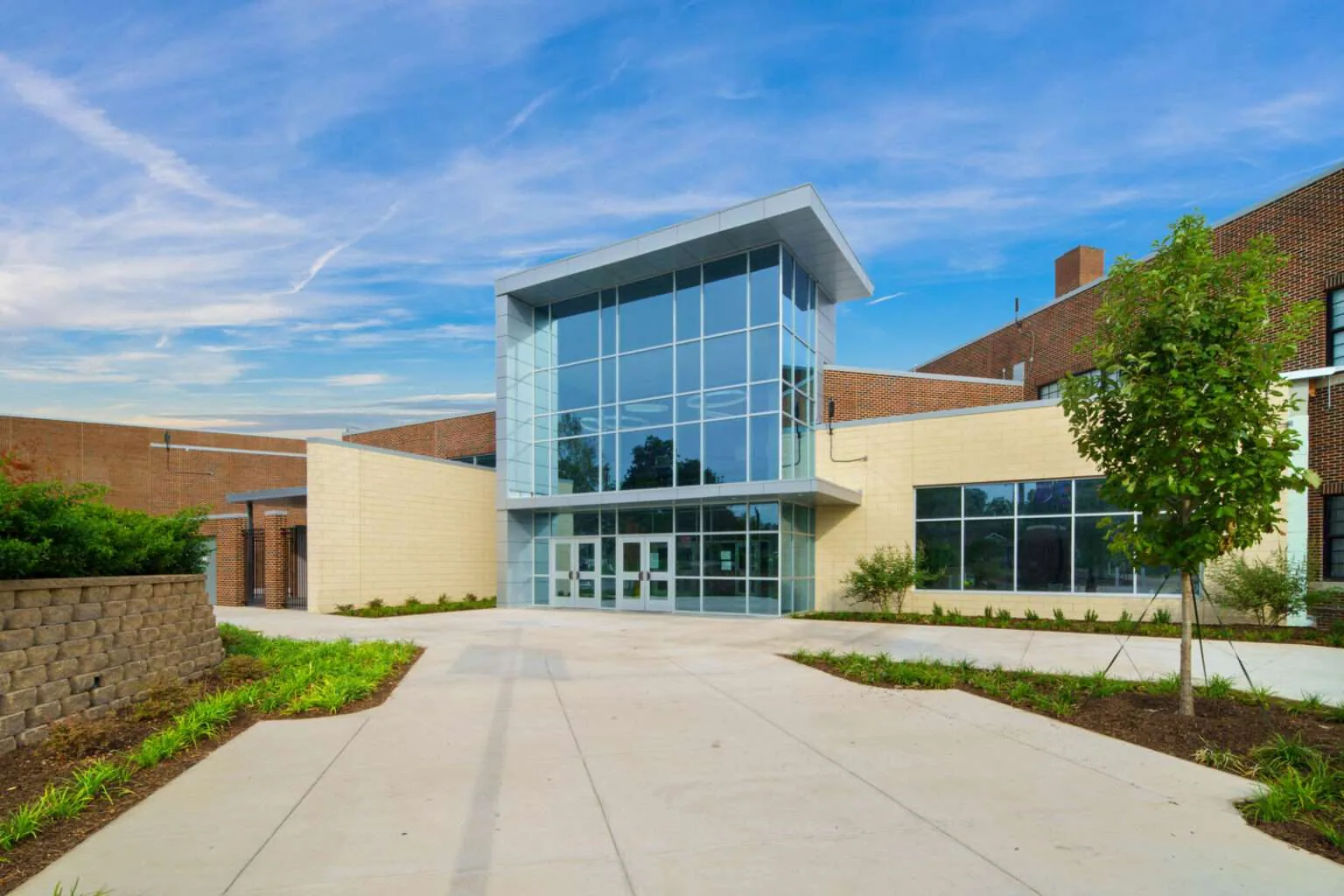
How many classrooms are under the part of the roof that leaks, and how many weeks are left before they fill? A facility director asks that with a bucket on the floor and a calendar on the desk, because a school roof lives on the academic year more than on the weather. The first thing an inspector finds on most low-slope school roofs near New Bedford, MA is that the wing with the stained tile and the wing with the failing seam are not the same wing, since water travels along the deck before it shows itself. We probe the seams, mark each finding on the roof plan and rank the areas by what sits underneath them.
That ranking is the working document for the summer, and the same method carries to college and university buildings. A gym, a cafeteria kitchen, a boiler room and a row of classrooms each carry a different cost of failure, and the plan should show it before bids go out.
What does the inspector find on a school roof built in several phases?
Most school campuses grew by additions, so a single building often carries three or four roof systems of different ages, joined at wall-to-roof transitions that were detailed by different crews. The inspector walks each section, identifies the membrane, and checks the junctions first, because that is where movement between the old and new structure opens the flashing. Fastener back-out shows on the older mechanically attached sections, and lap sealant that has dried and cracked shows on the oldest built-up and modified bitumen areas.
Gym and auditorium roofs deserve their own look. Their long spans flex under snow, and a deflection that leaves a shallow bowl in the deck holds water that a flat classroom wing sheds. We mark the low spots, check the drain sump and note whether tapered crickets would move the water to a drain.
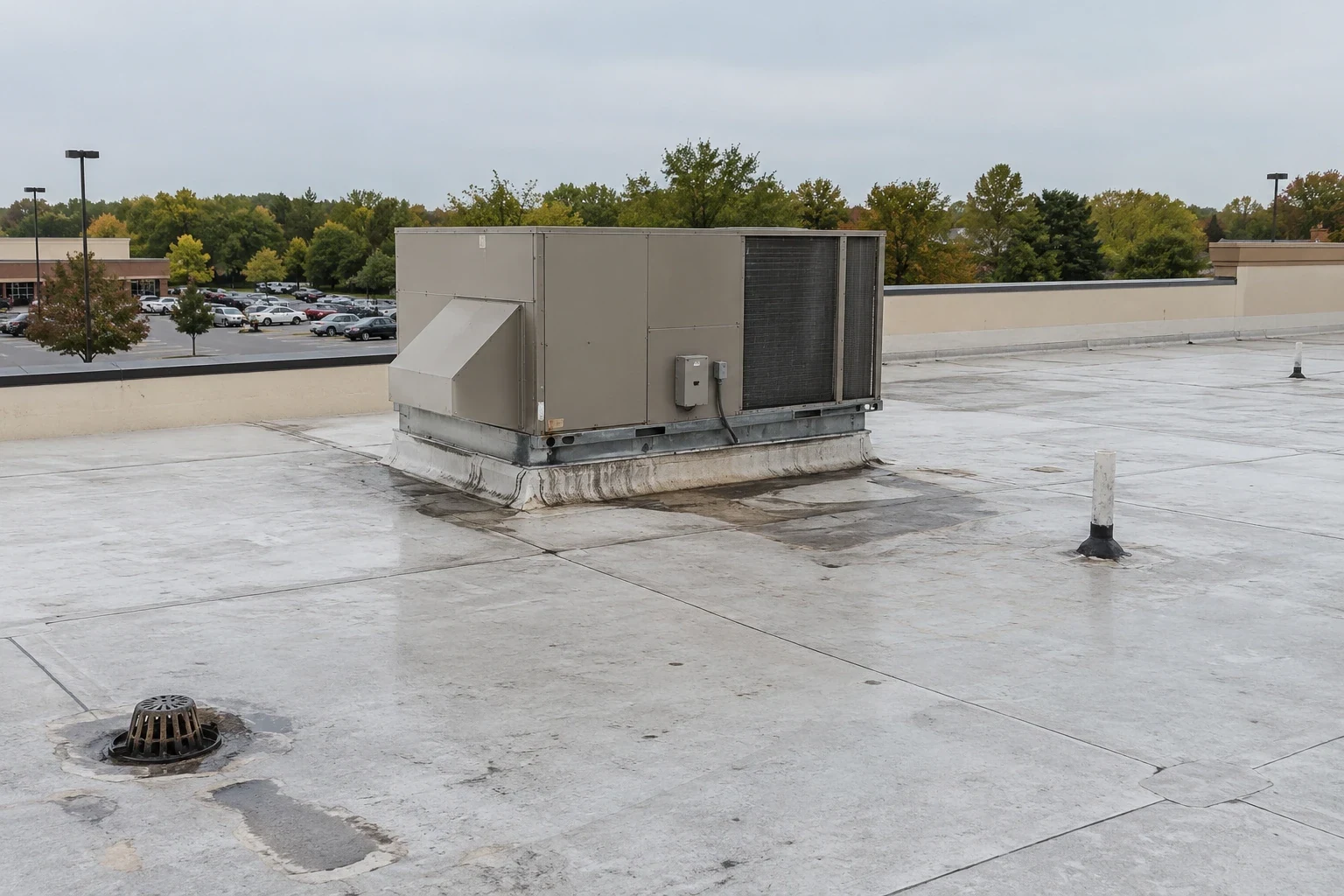
Rooftop equipment on a school is often an afterthought added in a later renovation. Ventilators, kitchen exhaust fans and heat pumps sit on curbs that were flashed to match whatever membrane was current that year, and the flashing seldom matches the sheet around it today. We check each curb, each refrigerant line support and each pipe boot, and we note any unit whose weight sits on the membrane instead of a curb.
Why does a summer schedule decide the whole project?
School roofing has a short window. Students leave in June and return in late summer, and the membrane work, the delivery of insulation and any crane time all have to fit inside it. A project that is bid in May faces lead times that have already used up part of that window, which is why we ask for the roof plan and the last inspection notes months ahead.
When a scope cannot finish in one summer, it is phased by building and by risk. The areas over occupied wings with active leaks go first, the sound roofs wait and a monitored interval keeps watch on them. Each phase is dried in the same day it is opened, so a September storm does not find a classroom open to the sky.
Funding calendars follow the same logic. A committee that sees the roof ranked by risk can place the first phase in the next budget and the later phases in the years after, with an inspection interval in between that tells it whether the monitored roofs are holding.
How much does snow and drainage matter on a school building?
Schools plan around roughly 32.5 inches of snow a winter, mostly December to March, and around storms like the January 2015 blizzard, which left 24.1 inches in Fall River and 26.0 in East Freetown. Snow on a school roof does not melt evenly: it stays on the north side, drifts against penthouses and parapets and melts at the drains where meltwater refreezes at night. That cycle opens seams and splits sealant at the same low spots every year.
We check every drain and scupper before winter, clear the debris that the fall leaves, and look for overflow paths that keep water off the wall if a drain clogs. Where the roof is a TPO or EPDM sheet, the seam probe tells us whether last winter's cycle has already started an opening.
Where a school has interior drains, we also look at the piping below the roof when the building allows, since a frozen or cracked leader can dump water into a ceiling that the membrane above is sound.
What does coastal wind do to the edge of a school roof?
Buzzards Bay saw 89 mph gusts with Bob in 1991, and Carol sent 80 to 110 mph winds across eastern Massachusetts in 1954. Schools near the water, from the academy in Marion to the agricultural high school farm along the Taunton River in Dighton, share that exposure in kind if not in degree. A long, low school building presents a lot of edge, and a loose gravel stop or lifted coping lets wind under the membrane.
At every parapet we test the edge metal and coping, flag fasteners that have backed out, and record where a heavier edge detail belongs in the next replacement. A new school roof has to meet 780 CMR 10th Edition, the state code resting on the 2021 IBC, which took effect on October 11, 2024.
What should a school facility team ask before a roof is replaced?
Ask what is under the membrane. A core cut and a moisture scan decide whether the insulation can stay under a recover or must come out, and they decide it with numbers instead of an assumption. Ask who handles the roof when a classroom is under it, how noise will be scheduled around testing days, and where the dumpster and crane will sit relative to bus lanes and playgrounds.
Ask for the findings by area, with photographs, so the school committee, which weighs the same questions it asks of any government building, sees the same roof the inspector saw. We keep that record in the roof condition report and update it after every visit, which lets a new facilities manager inherit it without starting over.
Commercial Roofing Questions
Which school roof areas should be inspected first after a hard winter?
Start with the drains and the low spots the snow melted into. Then check the junctions where additions meet, the gym and auditorium spans and any roof area over a kitchen or mechanical room. Seams are probed, findings are photographed, and everything goes on the plan ranked by how much the building below would suffer if it leaked.
Can a school roof be replaced while classes are in session?
It can be done in sections when the schedule allows, but it is usually better to do the heavy tear-off in summer and keep the school year for repairs. Where a section must be done during the year, we separate noisy work from testing days and use protected walkways away from entrances and bus lanes.
How do we decide between a recover and a tear-off on a school building?
Core cuts and moisture readings decide it. A recover needs dry insulation, a sound deck and a structure that can carry another layer, and the code limits how many layers a roof may have. Where any of those fails, tear-off is the safer path, and we show the readings that led there.
What belongs in the record a new facilities manager inherits?
The roof plan with areas lettered, the system and approximate age of each area, dated photographs, the list of open findings with locations, repair invoices and the next inspection date. With that file a new manager can see which roofs are stable, which are being watched and which are scheduled, and no one has to rely on memory.
Why does a school roof leak most in March?
Because winter stored its water in the snow and March releases it. Melt runs to the low points, refreezes overnight, and pushes through any seam or sealant joint the cold has already opened. The same spots show stains year after year, which is why we mark them on the plan and treat repeat locations as a sign that the detail, and not the weather, is at fault.
Ready to review the roof scope?
Request a Roof AssessmentKeep Reading